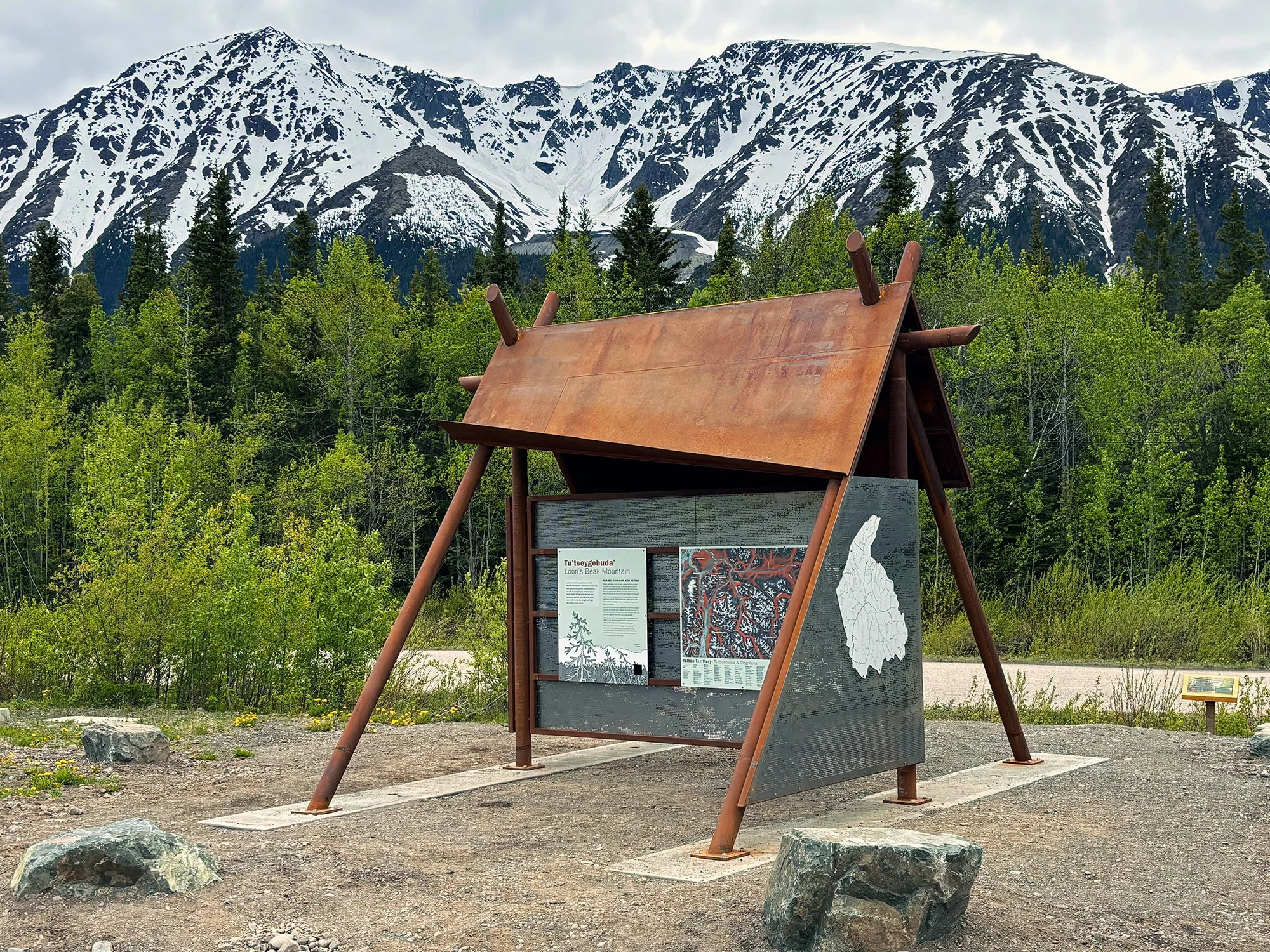
Kōjihge Pavilion
Kōjihge Pavilion is a sculptural installation rooted in the architectural tradition of Tāłtān Kōjihge — the campsites that have long anchored Tahltan people to their land. The form draws from both single and double lean-to shelter designs, translating ancestral structure into permanent public form. The awning design, evoking a tarp turned upward at its edge, extends the sheltered perimeter and invites visitors to stand back and read the walls from a distance, protected from the elements.
The pavilion represents the geography of a people — water and territory — as architectural skin. Constructed from weathering steel, the structures are built to endure. Custom designed perforated walls representing water support interchangeable content panels — maps, text, images, and artwork — creating layered depth that can evolve over time.
The walls display informational content panels and an artistic hydrology map rendered in silver mirror-finish Alucobond, with Tahltan water lines milled in low-relief by CNC. The piece reflects both sky and watershed — a cartography that is also a portrait.
2026
Weathering steel, Alucobond
Iskut, BC, Canada